Friday, August 16, 2013

Forestville State Park

In contrast to our last trip, this one went off without a hitch. We had the best weather and camping conditions we have experienced in a long time. Temps in the 70s, sunny skies, no bugs and an interesting place to visit. All we could ask for.

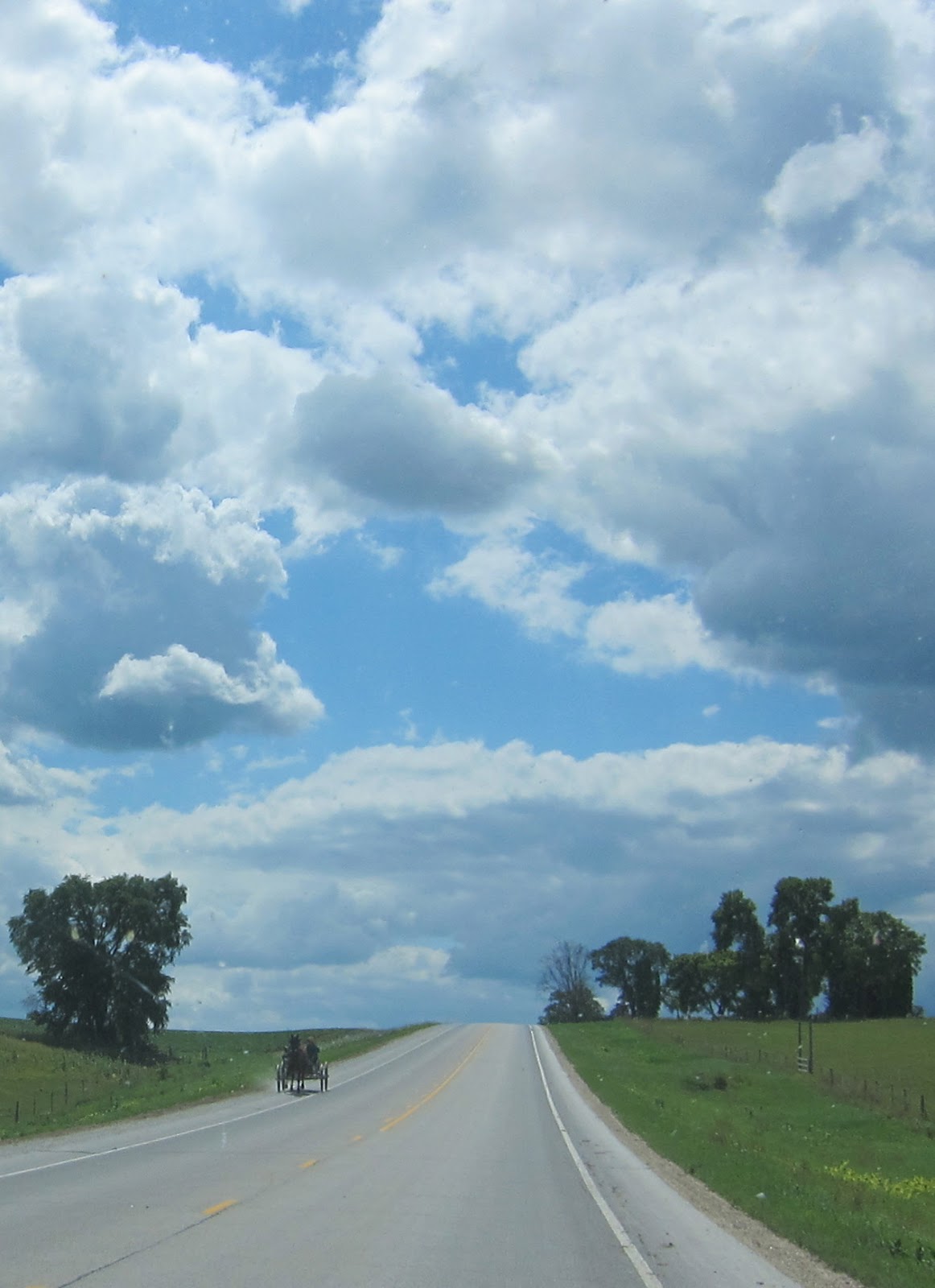
A panorama of the sky and fields in Southeastern Minnesota.
(Click photos for a larger version)

The destination was Forestville State Park, about 125 miles southwest of Minneapolis. We had a leisurely Monday breakfast, packed up and hit the road about 11 am. As is our custom, we looked at the map for the smallest roads we could find going in the general direction of our goal. We were driving through some of the prettiest parts of Minnesota farm country and with abundant rain this summer, the fields were in fine shape. We passed through or near towns with evocative names- Northfield, Hayfield, Blooming Prairie, Brownsdale, Grand Meadow, Spring Valley- arriving at the park mid-afternoon. Being Monday, we had our choice of campsites. We picked one closest to the river. Fishing was on my mind and the sound of the running water was nice to hear in camp.

South Branch Root River

Forestville State Park is known for 3 things: the abandoned town of Forestville; Mystery Cave, the largest cave in Minnesota; and trout fishing- 3 of the state's top trout streams converge in the park. Kathy and I both remember childhood visits to the cave, and we took our kids there as well. So that was not on the agenda this time.


We made camp in record time. We placed a few leveling blocks under the front wheels and pitched the awning and screen room. We took a short hike to check out our surroundings. We had this section of the campground all to ourselves. The river was flowing well. There were no bugs! It was time to test out the hammock that was a gift from my sister in Spain on our visit last summer.


The hammock is a great addition to our camp setup.

We didn't need the screen room this trip- no bugs.


A plate of Frank Raymond's flies.


After dinner, I decided to try my luck at fishing. I am a novice fly fisherman, having just picked up the sport again in the last year after inheriting my uncle's fly collection. Frank Raymond was a well-known fly tyer in Northern California back in the 60s and 70s. Kathy and I had a memorable trip in 1974 with him and his wife to the Mcloud River Conservancy which he helped to set aside. His daughter gave me his flies on the condition that I use them. So I have taken up fishing again. 


The park contains a section of the south branch of the Root River. The south branch gathers runoff from the fields west of the park before sinking into the limestone underlying the region. Its path through the rock serves to chill and clean the water. It flows through Mystery Cave, emerging downstream at Seven Springs as a cold water trout stream. Just inside the park boundary, Canfield Creek flows into the south branch, creating the most productive stretch of the river. Forestville Creek enters 2 miles further downstream. Both creeks flow from caves at 47 degrees keeping the south branch cool and ideal for trout.

Read more: http://www.flyfisherman.com/2012/08/29/minnesotas-south-branch-of-the-root-river/#ixzz2c5ftqrVC


Our camp was on the bluff above the river. I scrambled down the bank to a point where I could walk across the stream to the far side. I had scouted the river from above before hand. I wanted to cast back across to some deeper water along the bank under our camp. There was no surface activity. I had a good time practicing casting but caught no fish. I stepped into a hidden deep hole trying to pass a branch sticking out into the stream. Suddenly, from water that had been at my knees, I sunk like a rock up to my chest and water flowed into my waders. It was cold! I managed to regain my footing before it became a serious situation, but that and pending darkness put an end to that fishing session.

If you look closely under the big log you can see some nice fish hanging out.


I went back to camp and changed into dry clothes. I hung the waders to dry. We took a walk in the dark to look for shooting stars. The dense forest canopy offered few glimpses of open sky but what glimpses we got were filled with stars. We saw fireflies and heard owls hooting. Back in camp, we started a fire and dried my clothes while we watched the flames. Campfires are an integral part of our camping experience. With all the concern about invasive insects, state rules no longer allow you to bring firewood into the parks. It must be purchased on site. This adds a bit to the expense but I guess it is worthwhile to help save the forests.


The next morning, I resolved to have better luck fishing. I decided to fish upstream until I reached Canfield Creek. I would return in time for lunch. I left  Kathy in camp and proceeded to the river. I walked quite a ways upstream looking for good trout water. When I finally found some, there was already a guy fishing. Since the river was taking a turn there, I decided to cut around him through the woods thinking there would be a path. No path. The brush was thick. I went to the base of a ridge thinking it might be easier walking. I ended up taking an extended bushwack to get back to the river. With no compass and no map, I could have gotten myself good and lost, but I knew I had the park road somewhere on one side and the river on the other. I figured I would run into one or the other eventually. As it was I managed to find a pretty deep bramble patch, some deer beds and some pretty nice forest openings. Eventually I found my way back to the river and some nice spots but still no hatching insects or even many flying around. I eventually reached Canfield Creek. There was a large tree down in the river at the junction and I climbed out on it to see what I could see. There were large trout again hanging out under the trunk and no way to get a fly in there. Along the way I tried every kind of fly I had- cahills, tricos, midges, nymphs, ants, beetles, and more, but again was not successful in landing a fish. I think they just weren't eating. But that's what all the unsuccessful fisherman say. In truth, the disappointment was not too deep. I had a great time trying.


I walked back to camp with my waders over my shoulder and enjoying the beautiful summer day. Kathy had had a good time in the hammock and walking Rocky. We ate our late lunch and settled in for a lazy afternoon of reading and hammock testing. I had a cold beer from the fridge, a much appreciated camping luxury! The campground had filled up a bit during the day. We now had neighbors consisting of a grandpa and four boisterous teenaged boys. This is the hazard of camping in state parks and why we much prefer wilderness settings. But they are few and far between here. A spirited game of football was soon underway in the campground road. It was not a quiet afternoon. But they eventually wore each other out and things quieted down. We had a good dinner and relaxed with another nice campfire.

Rocky chillin in the sun.


The next day we had to pack up and head home for those darned responsibilities like jobs (Kathy's) and home maintenance (mine- never quite accomplished though). We decided to visit Forestville and take a long scenic drive home.

Forestville is an interesting place. It was founded in the 1850s by William Meighen beside the Root River. Meighen opened a fine brick general store in 1857. His son, Thomas Meighen worked in his father's businesses. The town thrived until the arrival of the railroad. When the railroad bypassed Forestville in favor of other towns, the town slowly declined until the store closed in 1910 and Forestville as a town ceased to exist.

While this is probably a common story for small towns of the time, what makes this one interesting is Thomas Meighen's dream to see the town site become a state park. He was a successful businessman. Over the years of decline, Meighen had become the owner of the entire town. With the park dream in mind, he preserved the buildings and the store, including the inventory remaining in the store at the time it closed. It took until almost 30 years after his death in 1936 for his dream to become reality. The park was established in 1963. The Minnesota State Historical Society now operates a living history museum there on weekends in the summer, set in the year 1899.

http://sites.mnhs.org/historic-sites/historic-forestville/history

We visited the site in the middle of the week and we were all by ourselves. We enjoyed poking around the town, imagining the life in the 1800s. I found a shutter to the store was unlocked which allowed a peek inside. Putting the camera against the glass, I managed to get a couple of dim photos. The shelves are stocked just as they were in 1899. The buildings are well-preserved with nice period details. It was a fun visit.
 
The Root River at Forestville

An historical view of the town.

The bridge is closed to vehicles and makes a nice entry to the town.


Meighen's Store.

A peek through the window into the store.

These bottles caught my eye.


The drive home took us through Minnesota Amish country. Harmony, Minnesota is the center of a large and thriving Amish community numbering several hundred families. The Amish practice a non-technological culture that preserves a way of life from times past. Their neat farmsteads and horse buggy transportation are a tourist attraction for many people. And the Amish benefit from the market for their crafts including quilts, furniture, basketry, produce and other items which they sell from their homes to people passing by. We took the back roads and enjoyed seeing the well-tended homes, fields and gardens. We pulled over to let a buggy pass on a very narrow road more suited to the buggy than our truck. We saw families dressed in the distinctive Amish manner. Generally we did not take photos as the Amish find photos offensive to their religion. We did take a distant snap of a buggy on the highway through the windshield, rationalizing they couldn't have been aware. I have to admit a certain longing for the simple lifestyle they practice, although I know little about their culture. The landscape and glimpses of a different culture made for a very satisfying journey.

Amish farm. Fun to see the handcrafted stacks- no machines.


Scenes of Minnesota bluff country.


We stopped for lunch at Beaver Creek Valley State Park. Beaver Creek emerges from the side of a limestone cliff making an instant creek. The water was cold and crystal clear. Evidence of a recent flood event was apparent throughout the park.


Cold, clear water- 4 feet deep here.
Beaver Creek


The creek flows out of the rocks on the right.


We drove through Caledonia, a small town where Kathy's grandmother grew up. We ended our trip by driving up the Wisconsin side of the Mississippi River valley. It is a scenic drive of epic proportions, at least for the midwest. The various Corps of Engineers dams create vast pools and wetlands across the broad valley edged with limestone bluffs. Charming small towns with names like Alma, Pepin, Stockholm and Maiden Rock entice you with cute shops and tasty looking cafes. Most were closed by the time we passed on a Wednesday evening. We stopped for pizza in Prescott and made the last leg home. A good trip it was!


Mississippi River Valley


Saturday, July 20, 2013

It was hot!

It was really hot- 95 degrees with 90% humidity hot. We decided to head north for some cool air. The alternative was to be stuck inside all week in the air conditioning. We settled on northern Wisconsin- not a long drive and a place we had never been sounded interesting- the Rainbow Lake Wilderness. The plan was to find a forest service campground in the Chequamegon National Forest close to the wilderness, hopefully beside a small, undeveloped lake where we could swim, fish and hang out. We would spend a day hiking in the wilderness, following old logging train trails to some wilderness lakes. A beautiful plan. We put the canoe on the roof and headed out.

As usual, we took the back roads to our destination, passing through the small towns and seeing what there was to see. We stopped at a small drive-in in Webster, Wisconsin for lunch. It was like a step back in time, complete with homemade root beer. The truck wouldn’t fit under the drive-in canopy, so we ate at one of the round tables with umbrellas- a perfect road trip experience.
Of course a beautiful plan is not sufficient. Back on the road, Kathy innocently asked if I packed the poles for the awning and screen room. I said yes. She asked where they were since she didn’t see them on the roof. I said they were in their usual spot under the dog platform.Then it hit me- I had packed the corner poles that knock down but had forgotten the framework poles that usually get fixed to the roof rack. I got sidetracked loading the canoe and forgot the poles. For a brief time, this was a major disaster in my mind, as I knew we would encounter bugs at the campsite. I quickly went to work thinking about solutions. I was pretty much resigned to cutting poles from the forest and lashing them together when I remembered the stash of parachute cord I keep in the bag of miscellaneous stuff that goes on every trip. I would string that from truck to poles and back to truck to take the place of the framework. Hopefully it would work.

We arrived at the Perch Lake Campground at about 3:30 in the afternoon. The rustic campground had two loops, north and south, situated by the small and undeveloped Perch Lake. We turned in to the south loop, well forested with dense understory creating secluded campsites. The truck was immediately under assault by deer flies- so thick we could hardly see past them. The windows went up quickly as we drove through the vacant campground. With some dismay, I said let’s try the north loop. It was better, with more open campsites overlooking the lake but several of the sites were occupied. We decided to stay and picked a nice site by the lake away from the other campers.


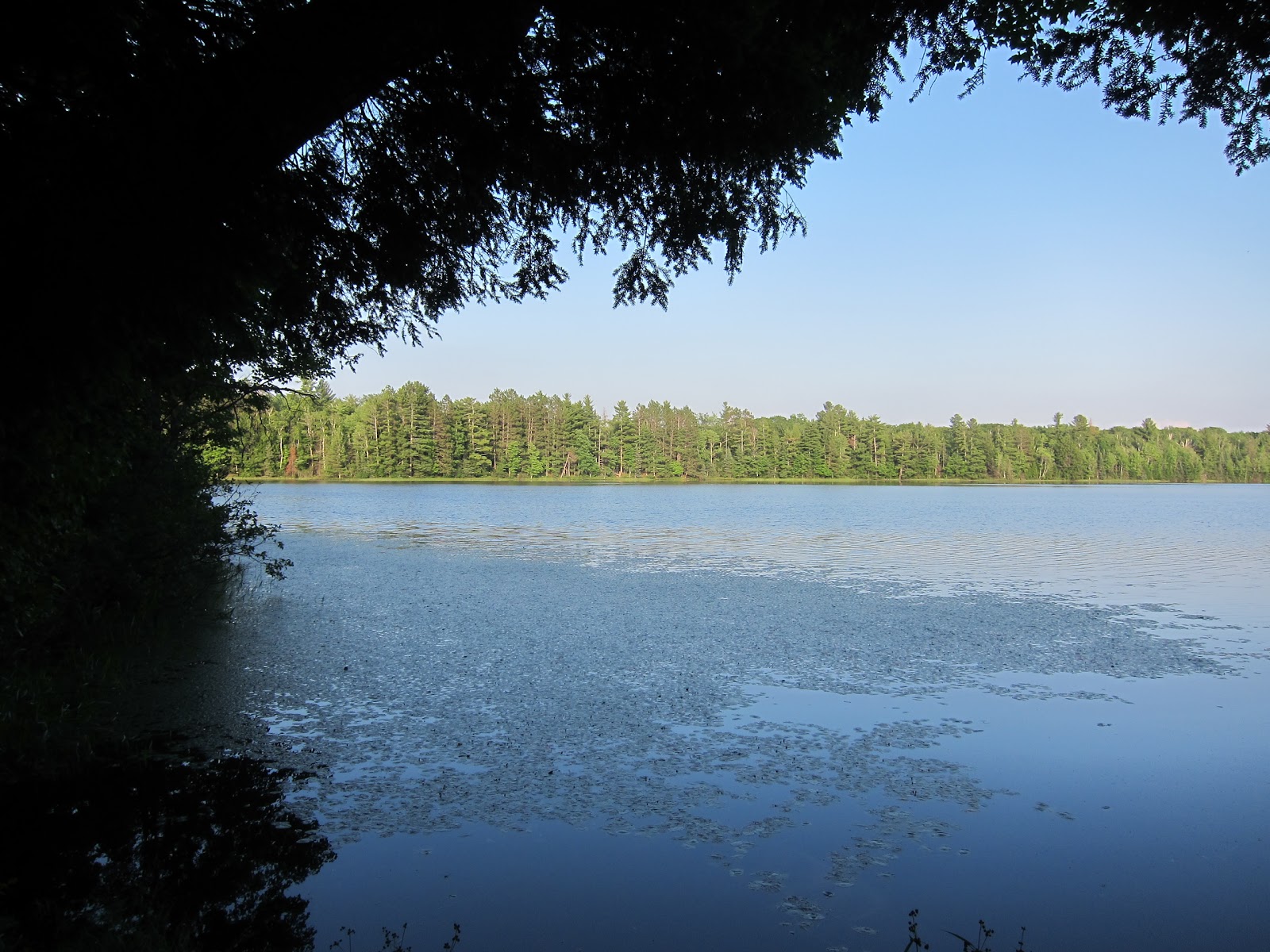
View of our campsite at Perch Lake

A pretty nice campsite but for the bugs.

View of Perch Lake

The awning and screen room setup went pretty smoothly. The parachute cord worked as a pretty decent replacement for the poles, although far from perfect. Unfortunately, the hoped for cool air was not in evidence. It was hot and muggy. Sweat was running off our bodies as we settled in. We took in the view of the lake from shore. The water was high due to the record breaking amount of rain this year. The bottom was sandy and would be nice for swimming. We decided to take a quick tour of the lake by canoe. It was a lovely summer day, but for the oppressive heat. A pair of loons were fishing and paid us little mind. An osprey flew overhead. Fish swirled in the shallows. Frogs burped. Things were as they should be on a lake in the summer. A bit refreshed, we concluded our tour of the lake and returned to camp.
Canoeing Perch Lake

Kathy is either flashing gang signs or checking out her latest fly bite while Rocky enjoys the view.

The afternoon waned, the slight breeze disappeared and the mosquitoes and flies came in search of dinner. Yikes! Into the shelter of the screen room. The bugs were so thick they clouded the air; so dense that by sheer numbers, a sizeable few found their way inside through gaps in the makeshift setup. They swarmed the outside of the screen. The sound of their buzzing was intense. Kathy likened it to a freeway in the distance, the incessant whine of truck tires passing. We sat in our chairs, slapped bugs when they landed and considered our options. Not many. I decided to make dinner while we discussed the considerable distance between our beautiful plan and reality. Clearly, walking in the wilderness was not going to be fun.
Thankful for our imperfect shelter, we ate dinner in relative comfort, considering the vast number of blood-sucking insects massing outside. We cleaned up and proceeded to make a new plan. We decided to head further north in the morning. The Apostle Islands in Lake Superior were not that far away and seemed like a good option. At least it should be cooler there by the big lake. With a new plan in place, we relaxed. I even decided to brave the insect hordes to go swimming. I needed to cool off and lose the layers of sticky sweat clinging to my body (Kathy was not equally motivated and stayed in the shelter). I wrapped a towel around me and ran to the lake, diving in before the bugs knew I was there. The water was refreshing! I swam and floated for a while. My commotion in the water alarmed the loons and set off a cacophony of loon calls, a sound unique and loved by those in the north country.
In the morning we set off for the harbor town of Cornucopia on Lake Superior. We had never been there. We followed the back roads and enjoyed the drive. As we approached the big lake, the temperature dropped- 10 degrees in 5 minutes. Awesome! Cornucopia was pleasant- we took a nice walk along the shore of Lake Superior enjoying the coolness, the sand and the sights. Walking along the big lake is very much like walking along the ocean, except there is no salt air. There are big, beautiful boats to look at and the water stretches to the horizon.

The beach at Cornucopia
An impressive driftwood construction


A nice place to sit.


After the walk, we decided to find a place to camp. We drove east to the Apostle Islands National Lakeshore. http://www.nps.gov/apis/index.htm After visiting several rustic campgrounds in the area, we settled on Russell Town Campground on Little Sand Bay. While more developed and focused on RVs than our preferred style of campground, it offered a location near the lake with a beautiful beach and an interesting historic commercial fishery to explore. The heat was building again, even by the lake. We settled in and Rocky and I took a walk down the beach. Kathy stayed in camp. I went for a swim in the cold water warmed by the sun.

Our camp at Little Sand Bay


The beach at Little Sand Bay. Lake Superior has amazing sand beaches and crystal clear water.


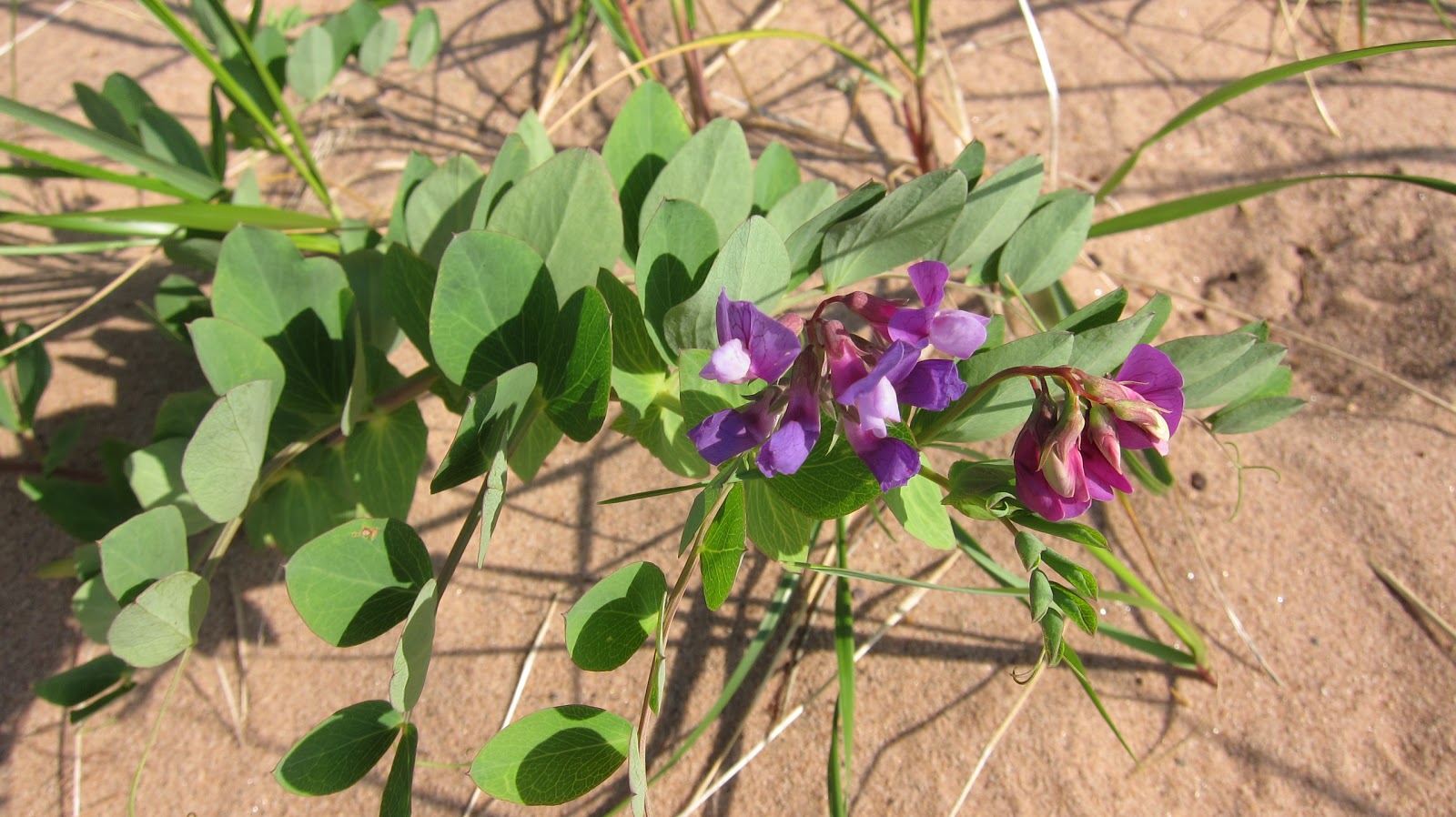
Beach Pea (native)


Later, we took another walk on the beach and explored the Hokenson Brothers fishery museum managed by the National Park Service. http://www.nps.gov/apis/historyculture/hokenson.htm We marveled at the work ethic required to make a living from the area in the early part of the century. The museum consists of the dock and fish house where the boats were unloaded and fish processed into barrels; the ice house where winter ice was stored for use in the summer; and the twine house, a shop where nets were repaired and stored and machinery was maintained. The house is also there and provides housing for park service staff. The evening saw another swim. This time Kathy went too.

Another fine beach.

The sand and the rocks it comes from.

Hokenson fishery dock in the distance.

Another nice place to sit.

Cooling off.

Come on in, the water's fine!


Orange Hawkweed (invasive)
Oxblood Daisy (invasive)
Common Blackberry (native)


The next day we drove to Meyers Beach to launch the canoe and explore a bit of the Lakeshore. The attractions are the sandstone cliffs and the sea caves eroded by the waves. http://www.nps.gov/apis/naturescience/caves.htm There are some cliffs along the mainland and more on the islands out in the lake. We were intent only on a short paddle near shore of the mainland.
There were probably 20 kayaks launching at the landing and us with our canoe. The good-natured park ranger came over and began his dissertation as to how they only recommended sea kayaks with wet suits, spray skirts and full rescue gear and about how unsafe canoes are in the big lake. He looked at our beat-up aluminum canoe, life jackets and our license plate and said- hmm, Minnesota, well maybe you know what you are doing. But he couldn’t resist telling a few stories of how people had lost their lives out there. He was doing his job and I appreciated it.
In truth, the canoe is not well suited for big water. I have been in canoes my whole life and I have kayaked in the islands before and knew what we were getting into. The lake can be calm one minute and stormy the next. Big boats make big waves and conditions can change rapidly. The problem is that the water is so cold that your body quickly loses its function if you fall in. You have maybe 15 minutes without a wetsuit. When you leave the beach and encounter the cliffs along the shore, there is no escape from the water except into your boat. A capsized canoe is of little use.
I assured him we were not heading far, would stay close to shore, and we headed out. The day was sunny and calm, the water was not troubled and neither was I. We paddled down the shore and around the first point to visit the first sea cave. It was impressive, extending back quite a ways and very high. I asked Kathy to hand me the camera from the pack for a few photos before we headed back to the safety of shallow water and the beach. She dug around a bit before announcing that we must have left it back at the truck. Bummer! No photos.
We paddled back to the beach, taking our time. We passed a pair of nesting bald eagles in a tree near their nest. They were having a conversation about something. Using binoculars, we couldn’t see any eaglets but the eagles were impressive. We stopped for lunch on the beach and I went swimming again. Rocky obliged and chased a few sticks into the water to cool off. Kathy discovered the camera in the pack after all (it was in a pocket with a water bottle- odd place for it). After a pleasant time on the beach, we decided to head for home. The sun was really intense and on the water it felt a bit like being in a reflector oven. We returned to the truck (to the relief of the park ranger), tied on the canoe and hit the road.

Meyer's Beach. We paddled around the point in the distance to visit a sea cave.


Beach lunch.
We again perused the map for the smallest roads home. Along the way, we drove through the Fish Lake Wildlife Management Area. Part of the Wisconsin Pine Barrens, 1500 square miles of sand plain left by the last glaciers, it is 14,000 acres of marsh, prairie and forest managed by the state of Wisconsin. Driving slowly, we flushed two sand hill cranes- beautiful- and saw wild turkeys, a couple of woodchucks, a coyote and fox dens.
We stopped again at the drive-in in Webster for a root beer float (with real ice cream) and drove the final leg home.
This was one of those trips where things did not go exactly according to plan, but we managed to have fun anyway. We resolved to return to the places we visited under better conditions, when we can appreciate their charms. Stay tuned for a fall trip to the Rainbow Lake Wilderness. Thanks for reading.